Red, Green and Infrared Lasers: Which One, If Any, Belongs on Your Gun
An aiming laser does one thing: it puts a dot where the gun is pointed without requiring you to look through the sights. That is useful in a handful of situations and irrelevant in most, which is why the honest guide to lasers starts with when not to buy one. Then it covers the three colours, the trade-offs between them, the difference between a laser that sits on a pistol rail and one built into a grip, and how to zero and maintain the thing.
When a laser earns its place
A laser helps when you cannot get the gun to your eye. Shooting from retention, from behind cover at an odd angle, with an injured arm, or while holding a light or a child in the other hand are the cases, and they are real cases for a home-defence pistol. A laser also helps a new shooter see what their trigger press does to the muzzle, which is why some instructors use them in dry practice. A laser does not help you shoot faster or more accurately in a normal stance; a red dot or good irons does that. If you want an optic, buy an optic. If you want a backup for the times the optic cannot be used, a laser is the answer.
Red lasers
Red is the original. It is cheap, it uses almost no battery, it works in the cold, and it is hard to see in daylight beyond a few yards. Indoors and at night a red dot on a wall is perfectly visible at room distance. On a compact carry pistol where size and battery life matter, red still makes sense.
Green lasers
The eye is far more sensitive to green than red, so a green laser of the same power looks several times brighter and stays visible in daylight to twenty-five yards or more. The cost is battery life, which can be a fifth of a red laser's, and temperature: most green lasers are diode-pumped and dim or fail below freezing and above the heat of a closed car in summer. Newer direct-diode green lasers have narrowed the gap on both counts but still cost more. For a home-defence pistol that lives indoors, green is the better choice; for a truck gun in a cold state, red.
Infrared lasers
An infrared laser is invisible to the naked eye and visible only through night vision, where it appears as a bright dot. It is the aiming method for rifles used with night-vision goggles, because a rifle scope cannot be used with goggles on. Civilian IR lasers are limited in power by federal rules and are still effective to a couple of hundred yards through a good device. An IR laser without night vision is a waste of money, and an IR illuminator, which floods a scene with invisible light for the goggles to see by, is a separate thing usually built into the same housing. The law guide covers the classification.
Rail lasers, grip lasers and light-laser combinations
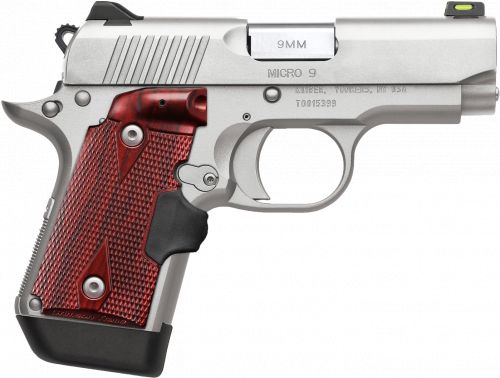
A rail-mounted laser sits under the barrel like a light and is activated by a button or paddle. A grip laser replaces a pistol's grip panels or wraps the backstrap and turns on when you take a firing grip, which is the most reliable activation there is and the reason grip lasers dominate on revolvers and small pistols without rails. A light-and-laser combination puts both in one rail-mounted body, which saves rail space on a compact pistol and costs some candela in the light; on a full-size pistol two separate units are usually better, and on a rifle they are always better.
Zeroing a laser
A laser is a straight line that starts an inch or more below and to the side of the bore, so it can only coincide with the bullet's path at one distance. Zero it at the distance you expect to use it: ten to fifteen yards for a pistol, fifty for a rifle. Use the windage and elevation adjusters with the tool supplied, small movements, and confirm on paper with live fire rather than trusting the dot against the sights. Some shooters zero a pistol laser so the dot sits just above the front sight at seven yards, which keeps it parallel and useful from contact distance out to twenty-five yards with an inch of offset at each end.
Lasers and training
The one place a laser earns its keep for every shooter is dry practice. Put a laser on a pistol you have confirmed unloaded, aim at a spot on a wall and press the trigger while watching the dot. Every flinch, every sideways push of the trigger finger and every tightening of the grip shows as a jump in the dot that you would never see through the sights. Ten minutes of this a week fixes more trigger problems than a case of ammunition. On the range, a laser also shows a new shooter how much the muzzle moves during recoil recovery, which teaches a proper grip faster than being told.
Batteries and maintenance
Most pistol lasers run on small lithium cells such as the CR2 or a pair of 1/3N cells, and green lasers eat them. Change the cell on a schedule, twice a year for a home gun, and keep a spare in the drawer. Clean the lens with a dry cloth; solvent and oil dull it. Check the zero after any drop and every few hundred rounds, because the adjusters on inexpensive lasers move under recoil.
A short decision list
- Home-defence pistol, indoors: green rail laser or a green light-laser combination, zeroed at ten yards.
- Carry pistol or revolver without a rail: red grip laser.
- Truck or cold-weather gun: red.
- Rifle with night vision: infrared laser with an illuminator; without night vision, no laser at all.
Read the weapon light guide if you have not settled the light question first, and browse lasers and lights in the catalogue.
General information, not legal advice. Current as of September 2026. Laws change; check the official source before you act.